
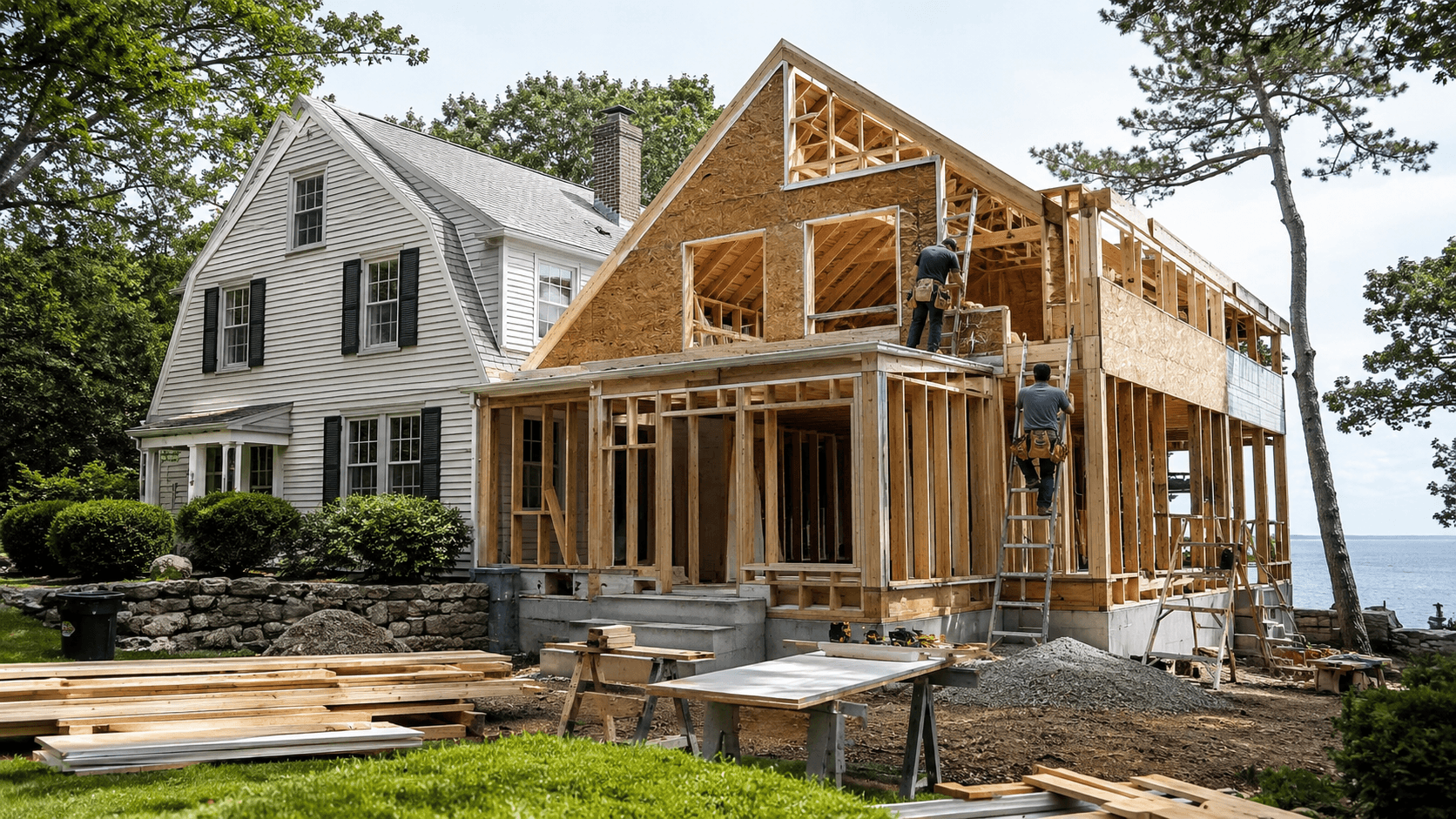
If you are a homeowner in Newburyport, Amesbury, Boxford, or somewhere else along the North Shore of Boston, you are aware of the reasons why our city is so coveted. We have stunning historic homes, pedestrian-oriented main streets, a charming coastline, and close proximity to Boston. However, every now and then homeowners find themselves considering a relocation, but more often than not, they choose to stay and add on instead. What are some things that affect home addition costs in the North Shore of Boston? Let’s break it down.
Cost of a Home Addition in the North Shore of Boston
In Massachusetts, home additions typically cost between $200 to $450 per finished square foot, based on size, complexity, and finishes. On the North Shore, the cost tends to be at the higher end because of the demand for skilled labor, the age of many properties, and historic design requirements. Typical home additions can range between:
- Family room addition (approx. 400 sq. ft.) – $90,000-$150,000
- Master suite addition – $150,000-$350,000
- Second story addition – $200,000-$500,000
- Bonus space above garage – $60,000-$180,000
- Sunroom / Three-season room – $50,000-$130,000
- Kitchen bump-out – $50,000-$150,000
- In-law suite or additional dwelling unit – $120,000-$300,000
These figures are only estimates. Each property is unique, and certain aspects such as conditions of the foundation, utility work, setbacks, zoning bylaws, etc. will affect final pricing. If you decide to work with a design-build contractor, they’ll be able to provide you with a more realistic budget after examining your home.
What factors affect the cost of a home addition in the North Shore?
Foundation and Structural Work
Foundations will influence costs the most. Adding on to a house that already has a slab, crawlspace or is located on difficult soil may require additional excavation and engineered solutions. Adding to the second story also means additional structural modifications to the house so that the structure is strong enough to support the new addition.
Historic District Requirements
Many municipalities (Newburyport, Ipswich and Essex) may also require design and construction plans to be approved by a board or committee within the historic district that an addition falls under. Often in a historic district, the design must be consistent with the style and the construction materials must match those of the house and other homes in the neighborhood as well. Working with a design-build contractor who is experienced with local boards or design committees will save a lot of time and money.
Interior Finishes
Finishing choices are also a big factor in the costs. Adding on a bathroom will always cost more than adding on a laundry room or play room. Features such as custom cabinetry, tile showers, radiants, high-end fixtures, bookcases and built-ins, and decorative trim will increase costs, but a more finished product will help your home addition match the existing home better, increasing its value.
Mechanical Systems
Depending on your home addition, new space may require additional work in your heating, air conditioning, plumbing, and electrical system to accommodate it. Older North Shore homes often also have outdated electrical and mechanicals systems that will need to be improved or upgraded to code prior to making the construction more efficient.
Access to Property
If your house is on a tight lot, lacks space for staging, has a steep grade or a large number of mature plantings, labor costs can skyrocket. Limited street access can make transporting material and equipment on and off the site more time-consuming and expensive.
Is a home addition worth it in the North Shore?
The answer is often yes. Well-conceived home additions in desirable communities like Newburyport, Boxford, and Georgetown generally hold value while improving livability. Popular additions that enhance resale value are kitchen expansions, additional bathrooms, and in-law suites. Second-story additions tend to run a little higher on price, but they provide significant gains in square footage without expanding a home’s footprint—making them particularly helpful in the case of smaller lots.
Beyond resale value, one of the biggest perks of a home addition is the way it transforms how your family lives at home. Often, years of increased comfort and functionality will more than make up the difference compared to just calculating return on investment.
How to Budget for a Home Addition
It’s wise to budget ahead of time.
- Consult with a design-build firm that will be able to offer a budget based on your project’s needs and your property.
- Allow for a 10-20% “wiggle room” or contingency for unexpected conditions—something that’s all the more likely the older the home.
- Identify the specific finishes that are the most important to you; that way your budget matches your priorities.
- Don’t forget “soft costs” like architectural design, engineering, building permits and, if applicable, historic design review, which can add 10-15% to your project budget.
- Be aware of labor costs and material costs, which can fluctuate depending on the time of year and availability.
Why Choose a Design-Build Contractor?
With a design-build firm, a company is responsible for managing all aspects of the project, from design through construction. Because one company is overseeing the design and build process, accountability is maintained throughout the process. Since the same people who prepare the plans are the ones who will build them, your budget will align throughout the project and you’re more likely to get the results you’re after. With more consistent communication between you and your contractor, potential issues can be identified and resolved more easily.
Since 1982, Greene Design and Build has been a mainstay for the North Shore home addition and renovation market out of its Newburyport offices. In addition, owner Greg Greene continues to remain engaged in every project and the company keeps clients in the loop with regular day-by-day updates once construction starts. The firm has built more than 25 custom homes as well as hundreds of other additions and remodels, including master suites, in-law suites, second-story additions and historic restorations. Greene Design and Build has deep familiarity with building codes, historic commissions and historic home restoration throughout the North Shore to make sure that every addition is both compatible with the existing home and with the surrounding neighborhood.
Begin Planning Your Home Addition
If you’ve been thinking about a master suite in your home, an in-law suite to house family or a second-story addition that expands your home to gain more overall living space, successful home additions always begin with planning. Greene Design and Build can review your property, learn more about what you would like to achieve and offer professional insight on what that looks like in terms of scope, budget and next steps.
Call 978-790-4881 or stop by greenedesignandbuild.com to request a consultation.
Frequently Asked Questions
How much does it cost to build a room addition per square foot in Massachusetts?
Most home additions will cost $200 to $450 per square foot of finished space. In the North Shore, home additions often run towards the higher end of that range, due to labor costs, older homes and potential requirements of historic districts. The most accurate price estimate can only be provided following an on-site evaluation.
Does a home addition increase my home’s value?
Yes, a home addition will generally increase a home’s value. This will hold true especially for North Shore communities where home addition projects are in demand and homes remain at a premium. Kitchen additions, additional bathrooms and even in-law suites will typically yield the best return on investment, especially when the design matches the rest of the home’s architecture.
How long does a home addition project take?
Most home additions in the North Shore take six to fourteen months to complete. Initial design, permitting and, if applicable, a review by a historic commission typically takes two to four months, while construction can take anywhere from four to eight months depending on the project and its size.
0 Comments